
Guide to South Carolina Divorce Records
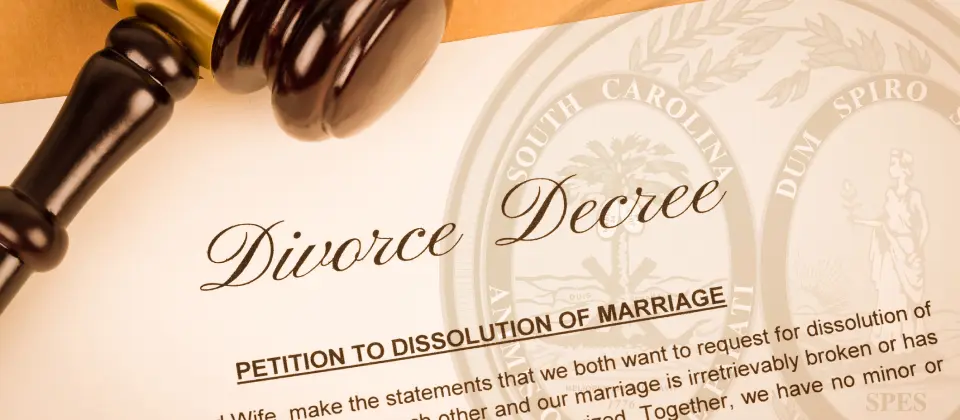
Divorce in the United States is primarily regulated by individual states. Therefore, each state, including South Carolina, has different laws regarding divorce and the process for obtaining divorce-related information and records.
In South Carolina, a divorce, also known as a dissolution of marriage, is initiated once one spouse files a complaint for divorce with the Family Court of the county where either spouse lives. Family Courts address all family law matters, including divorce, child custody, child support, and spousal support (also called alimony).
Once the court completes review of the case to ensure that all requirements have been met, it will issue a Final Judgment of Divorce, terminating the marriage. During a divorce proceeding, the court issues multiple documents. These documents make up the complete South Carolina divorce record.
A common South Carolina divorce record includes:
Names of both spouses
County and Family Court where the divorce was originally filed
Case number and date of original filing
Reasons for the divorce (fault-based or no-fault)
Custody arrangements for children and child support obligations
Orders for spousal support (alimony)
Agreements and orders for the distribution of marital assets and debt
Public access to South Carolina divorce records is generally available at the state and county levels. However, certain personal and sensitive information, such as financial data and information pertaining to minors, may be restricted from public access.
Knowing how divorce records are created, what they contain, and the court's approach to property division and custody can help you understand South Carolina's divorce process and quickly find the records you need.
Where Are South Carolina Divorce Records Stored?

South Carolina maintains divorce records at the county and state levels.
The most comprehensive divorce records for any divorce case will be found at the South Carolina Family Court in the county where the case was initiated. County court records include all documents involved in the case, such as the complaint, summons, responses to the complaint, temporary orders entered by the judge, financial disclosure information, and the Final Judgment of Divorce.
At the state level, the South Carolina Department of Health and Environmental Control maintains an indexed divorce record dating back to 1962, which lists divorces throughout the state and provides certified copies of divorce certificates. The information contained on this index is limited. It typically includes only the spouses' names, the date of the divorce, and the county where it was granted.
Divorce records in South Carolina are also stored in either a digital or physical format. Many older divorce records are available in paper form and may be stored in state or county archives. More recent divorces are processed electronically and stored online by the county courthouses where they were filed.
Is South Carolina a 50/50 Divorce State
South Carolina does not follow the “50/50” divorce model. Under South Carolina Code Section 20-3-620, the state follows the Equitable Distribution model. When a couple divorces in South Carolina, the judge divides marital property in a way they believe is fair and reasonable. However, there is no guarantee that it will be divided exactly 50/50.
When determining how to equitably distribute marital property, the judge will look at the following factors:
Length of the Marriage: If one party was married for an extended period of time, the judge will consider dividing the marital property more evenly. If one party was married for only a short time, the judge will more often seek to return the parties to their premarital positions.
Contributions of Each Spouse: This can include the financial and non-financial contributions made by each party.
Income and Earning Capacity: When dividing marital property, the judge will evaluate each party's present financial situation and the future ability of each party to earn income.
Marital vs. Separate Property: Only marital property obtained by the couple during the marriage is subject to distribution. Property that is separate from the marital relationship or received as a gift or inheritance is usually excluded.
Fault Considerations: South Carolina is a fault-based divorce state, which means that parties to a marriage may seek a divorce as long as there has been marital misconduct. Courts in South Carolina may also take into account whether marital misconduct occurred, which caused some type of financial impact on the couple's overall net worth. However, fault alone does not automatically determine how assets are to be distributed among the parties.
Types of South Carolina Divorce Records

There are two main types of divorce records in South Carolina, each with a distinct use. The first type is for simple verification and provides the most basic information, while the second type is the complete legal report on the divorce.
South Carolina Divorce Certificate (Certificate of Divorce)
The divorce certificate in South Carolina is a brief document issued by the South Carolina Department of Public Health. This document confirms that the divorce occurred but contains no additional details about the process.
Typically, a divorce certificate includes the names of both parties, the date the divorce was finalized, and the name of the county where it was granted. Divorce certificates are generally used for identification purposes, when filing for a remarriage license, or for many other administrative needs.
The divorce certificate is not an acceptable substitute for the full court decree. Therefore, it cannot be used to either enforce or review the terms of your divorce.
Divorce Decree (Final Judgment of Divorce)
The divorce decree (also referred to as the Final Judgment of Divorce) is the most important and legally binding document. It is prepared and signed by the judge of the South Carolina Family Court in the county in which the divorce was finalized. Unlike a certificate, the divorce decree provides detailed information about the court's final decision, which is enforceable. A divorce decree is required when disputes arise or when it is necessary to establish the exact terms of the divorce.
A typical divorce decree from South Carolina may include:
Property and Debt Division: This section determines how all marital property and debts will be divided between the two spouses.
Child Custody and Support: This section outlines the legal and physical custody arrangements for minor children, the visitation schedule, and the specific child support obligations of each spouse.
Alimony: If alimony has been ordered, this section will outline the type of alimony being paid, the amount of alimony being paid, and for how long the alimony will be paid.
Date of Final Judgment: This is the date the judge signed the divorce decree, and therefore the date the marriage was officially dissolved.
In general, because the divorce decree contains detailed information about the couple's financial obligations and the children, this document is typically required when enforcing a financial obligation or child custody. The divorce certificate, on the other hand, is typically all you would need if you simply want to prove you were married and then divorced.
How to File for Divorce in South Carolina (Step-by-Step)
Before you file for divorce in South Carolina, at least one spouse must meet South Carolina's residency requirement. As outlined in section 20-3-30 of the South Carolina Code, if both spouses reside in the state, a case may be filed in the county where either spouse resides. If only one spouse lives in the state of South Carolina, that spouse must have been a resident of South Carolina for at least one year prior to filing. This rule is intended to ensure the court has proper jurisdiction over the case.
In addition to meeting the residency requirements, South Carolina law requires an acceptable reason for the divorce (also referred to as a “ground” for the divorce). An acceptable reason for divorce under South Carolina Code Section 20-3-10 may include:
No-fault separation, requiring that the spouses have continuously resided apart from each other for one (1) year; or
Fault-based grounds such as adultery, physical cruelty, habitual intoxication, or desertion.
Before taking the final steps to file for divorce, it is important to determine whether the divorce will be uncontested or contested.
Uncontested Divorce: When both parties agree on all aspects of dissolving the marriage before filing the divorce papers, it is known as an uncontested divorce. Such agreements include the division of marital property, the type of custody arrangement that best suits your family's needs, and the amount of financial assistance each party will provide.
Because there is no need for the courts to resolve disputes, an uncontested divorce usually has a shorter time frame, is less costly, and typically requires little to no court involvement. Usually, the court will hold a short hearing to review the divorce agreement before rendering the final order.
Contested Divorce: A contested divorce occurs when the parties cannot agree on at least one key issue, making the divorce process more complex. Contested divorces may involve the exchange of financial documents, temporary hearings to resolve issues arising from the pending divorce, and attempts to negotiate or mediate a settlement of the disputed issues.
If the parties are unable to reach a settlement, the case will likely go to trial. The trial will result in a final decision by a judge on the disputed issues.
Step-by-Step Divorce Process
Filing for a divorce varies by county, but generally follows the same steps.
Prepare the Filing Packet
The first step in filing for divorce in South Carolina is to prepare a complete, compliant Family Court filing package. The filing package contains all necessary paperwork for opening your case and informing both the court and the other spouse of your intention to get divorced.
Identify the Divorce Path (1A vs. 1B): Before filing, determine whether your divorce will be uncontested or contested.
Typical Documents: Gather the following documents:
Complaint for Divorce: Initiates the case and cites the legal reasons for divorcing.
Summons: Officially informs the other spouse of the lawsuit and the necessity to respond.
Financial Declaration: Provides an accurate account of your current income and expenses, as well as a list of your property (both personal and real) and your liabilities.
Certificate of Exemption or ADR Statement: Indicates if the case is exempt from mediation or alternative dispute resolution.
Family Court Cover Sheet: Supplies administrative data on the case for the court.
Acceptance of Service or Affidavit of Service: Verifies that the other spouse has received the divorce papers.
Other forms include the Certificate of Exemption, the Request for Hearing, the Final Order of Divorce, and the Judgment in a Family Court Case. South Carolina's divorce filing packets are available online through the Simple Divorce Packets webpage.
In addition, other necessary documentation includes a copy of the couple's marriage license, income statements, a list of each spouse's assets, and a cover sheet that states this is a domestic relations action. Others include an itemized list of the couple's property, proof of their respective residences, and any court-ordered documents regarding the children.
Filing Fees and Fee Waivers (Indigency): Most counties charge a $150 filing fee. Some counties may also charge additional costs for service of process or certified copies of court documents. If you cannot afford the filing fee, you may apply for a fee waiver by submitting the Motion and Affidavit to Proceed In Forma Pauperis (Form SCCA/405). If your application is granted, you will be able to file your case without paying any upfront fees.
File the Case
Once you've completed your divorce filing package, it's time to officially file your divorce case with the court.
Where to File: All divorce cases in South Carolina are handled by the South Carolina Family Court. You will need to file in the Family Court in the county in which one or both spouses live, since that court will have jurisdiction over the case.
Filing Methods: You can file your divorce papers using one of three methods:
In Person: Go to the Family Court Clerk's Office to file in person. A clerk will review your filing to ensure everything is correct, then process your documents.
Mail: Many counties also offer the option to file a divorce request by mail. You will mail in your completed documents, a check for the filing fee, and any additional documentation requested.
Electronic Filing (e-filing): Depending on the county or case type, some counties use electronic filing systems. These systems allow you to file electronically via the court's system.
What You Receive: After filing a petition in divorce court, the court processes the paperwork and provides you with the following information:
Your case number, used to track your case, to be included on all subsequent pleadings
A summons to formally serve the other party in your divorce lawsuit, if it is a contested divorce
Initial court communications regarding scheduling and procedures
Service of Process (Primarily for Contested Cases)
After you file your divorce case in South Carolina, the next hurdle is the service of process. The service of process is the means by which your spouse will be informed of the pending divorce and legal action. Service of process confers jurisdiction on the court to hear the case. It also provides your spouse with the opportunity to take part in the case.
There are multiple ways service of process can be done.
By the sheriff's department
By a private process server
By certified mail
After the service of process is completed, the process server will file the proof of service with the court.
If the filing spouse is unable to locate the other spouse and has made all reasonable attempts, South Carolina law allows for alternative service. Alternative service includes, but is not limited to, service of process by publication in a newspaper approved by the court or by sending the documents to the other spouse's last known address. To use this method, the filing spouse must show the court evidence of diligent attempts to locate the other spouse.
Early Case Phase and Temporary Orders
Once service of process has been completed on the other party, the case will move into the early case phase. Here, the court may enter temporary orders to help create a stable environment while the case is ongoing. Temporary orders are not final but are enforceable and intended to promote equality and limit conflict until a Final Judgment is entered.
One of the most important aspects of the early case phase is creating and maintaining the “Status Quo.” In general, courts will attempt to preserve existing habits or financial arrangements for both parties as much as possible until a final decision is made.
The court may also determine:
Temporary Custody/Visitation: Where the child will reside and what parent-time arrangement will be established to provide stability.
Temporary Child Support/Spousal Support: What amounts of money each party will pay towards the cost of living for the parties and their dependents during the case.
Exclusive Use of Marital Home: Who gets to live in the family home so that there can be less conflict with the other party.
Protective/Restraining Orders: To limit contact between parties when there is concern about either physical harm, emotional abuse, or harassment.
Financial Disclosures and Discovery
As a divorce case unfolds in South Carolina, spouses must provide the court with a full and honest accounting of their finances. This helps the judge make an informed decision on how to divide the couple's marital property, decide support (both spousal and child), and address other financial issues related to the divorce.
Mandatory Financial Statements: Both spouses in South Carolina are required to file a financial affidavit (financial declaration) early in the divorce proceedings. This affidavit is a detailed summary of the spouse's financial situation, including income, monthly living expenses, assets, and liabilities. Both spouses' affidavits must contain truthful and complete information.
Supporting Documentation: Your financial declaration must be supported by documentation verifying the information it contains. The typical supporting documentation will include pay stubs, tax returns, bank account statements, credit card records, mortgage agreements, loan agreements, and any other applicable contractual agreements.
Discovery Tools: If the spouses do not agree on financial issues, or if one spouse believes the submitted financial information is inaccurate or incomplete, South Carolina Statutes allow the use of discovery tools to obtain additional information. The use of these discovery tools helps to ensure that all relevant financial information has been provided prior to the conclusion of the case. Some discovery tools include:
Request for Documents: A written request to the opposing spouse requesting copies of particular financial documents, including but not limited to financial statements, title to real estate, or any agreement.
Written Interrogatories: Written questions submitted to the opposing spouse who must answer them in writing under oath.
Subpoena: A court order requiring financial documents to be produced by a third party, such as a bank or employer.
Deposition: A sworn testimony of either a party or a witness in person, and the response will be recorded for future use at trial.
Case Management and Court Conferences
The court may hold case management and pretrial conferences to track the case's progress and attempt to settle it prior to trial.
At a case management conference, the court may discuss case deadlines, verify completion of financial disclosure obligations, and establish time frames for either discovery or mediation.
Typically, a pre-trial conference will occur later in the litigation process, especially when the parties are actively litigating. At this time, the judge will evaluate how ready each party is for trial, identify the remaining issues to be resolved, and often encourage settlement discussions. Additionally, the judge may consider evidentiary issues, witness lists, and any outstanding motions.
At this point, judges generally expect:
Parties have filed complete and accurate financial disclosures.
Parties have complied with all court deadlines and procedural requirements.
Each party has made good faith attempts to resolve its disputes or to participate in mediation.
Each party clearly identifies the issues that they believe are contested (property, custody, support).
Each party is ready for trial and has prepared evidence and witness lists.
Settlement or Trial
Most divorce cases in South Carolina are settled prior to going to trial by using one or more of several settlement options. Settlement provides each party with greater control over the final agreement. It also decreases the time, money, and stress associated with litigating. The most common ways to settle include:
Negotiations directly between you and the other party
A mediation process involving a neutral third party
Settlement negotiations led by your attorney
If no settlement is reached, the case will proceed to trial in the South Carolina Family Court. When your case goes to trial, you can expect the following to occur:
Evidence will be presented, and witnesses will testify.
You will submit your proposed findings of fact and conclusions of law.
The court's final decision on all remaining issues
Judgment, Waiting Periods, and Finalization
South Carolina has its own laws that set out how long it takes for a judge to make a final decision about a divorce.
The 90-Day Wait: According to South Carolina Code Section 20-3-80, there is usually a 90-day wait after you file your complaint with the court before a judge can sign a final divorce decree. The 90-day wait gives you time to think about whether you want to reconcile with your spouse.
The Remarriage Ban: South Carolina, unlike some other states, does not have a waiting period before one can remarry after a divorce. On signing and filing the Final Judgment of Divorce by the judge, both parties are immediately allowed to remarry.
Child Custody and Child Support in South Carolina Divorces
When making decisions about children in South Carolina, courts rely on the “best interests of the child” rule. The judge will assess all appropriate factors to determine which arrangements are most likely to benefit the child, both in terms of their overall development and their stability. The Family Court may consider the following factors when evaluating the best interests of the child:
What type of relationship does the child have with both parents?
Which parent can provide the most stable, safe environment for the child?
How capable is each parent to provide care for the child?
Is there a history of misconduct or instability with one of the parents?
If the child has reached an appropriate level of maturity and age, what is the child's preference regarding living arrangements?
Legal Custody vs. Physical Custody
Custody of children in South Carolina is made up of two parts: legal custody and physical custody. Legal custody refers to which parent has the right to make major life decisions for the child, such as educational matters, medical care, and the religion to be practiced. Physical custody refers to where the child will reside and how much time each parent spends with the child.
The court awards either sole or joint custody to one of the parents based on which arrangement is in the “best interest” of the child. In addition to determining custody, courts assist parents in developing a parenting plan that provides a stable environment for the child and allows both parents to continue participating when appropriate.
Child Support Guidelines and Enforcement
Child support in South Carolina uses the Income Shares Model to calculate child support based on the following criteria:
Income of both parents
Number of children
Healthcare and child care expenses for all children
Amount of time each child spends with each parent
These factors are used to ensure that the child's financial needs are met in a fair and consistent manner. Once ordered, child support is enforceable by law. Failure to comply with an order can cause some of the following actions to be taken against you:
Garnishment of your wages
Interception of federal or state tax refunds
Suspension of your driver's license or professional license
Any other legal enforcement actions available to the court, including jail time or fines
Property, Debt, and Alimony in South Carolina Divorces
In South Carolina, divorce courts resolve financial matters, including the division of marital assets and debts, and the determination of alimony, based on the principles of equitable distribution.
One of the first steps in the process of determining how to divide the marital estate between the two spouses in a South Carolina divorce proceeding is to distinguish marital property from separate property.
Marital property consists of all assets and liabilities that are incurred or acquired by either spouse during the marriage. Who holds legal title to an asset is irrelevant to this definition. Examples of marital property would include income, real estate (the marital home), retirement accounts, and other forms of personal property.
Separate property includes assets that were owned prior to the marriage. Separate property also includes inheritances or gifts that are made to only one spouse.
Only marital assets can be divided. Separate property cannot be divided. However, when separate property is commingled with marital property, it may lose its separate status.
Debts are handled similarly to assets in a divorce in South Carolina. In this regard, the court identifies what is marital and what is separate and assigns responsibility for marital debts equitably. For example, marital debts could include mortgage payments, credit card balances, vehicle loans, and other obligations incurred during the marriage. When determining how to equitably distribute marital debts, the court will consider:
Who incurred the debt
The purpose of the debt
Each spouse's ability to pay the debt
Whether or not only one spouse or both spouses benefited from the debt.
The overall division of all marital property
The courts can award several forms of spousal support. Depending on the circumstances of the parties, there are four types of spousal support that can be ordered in South Carolina:
Periodic Alimony: Ongoing support where payments are made regularly (usually monthly). It will continue until the payee marries again or there is a material change in circumstances.
Lump-Sum Alimony: Award of a specific dollar amount, paid all at once, or paid over time. Once a lump-sum alimony award is made, it cannot be modified.
Rehabilitative Alimony: Temporary support for a spouse to get back into the workforce by going to school, getting job training, etc.
Reimbursement Alimony: Allows a spouse to receive compensation for expenses incurred in supporting the other spouse's educational or career development during the marriage.
Errors, Omissions, and Corrections in South Carolina Divorce Records
Errors on South Carolina Divorce Records include misspelled names, wrong dates, omitted case details, or clerical errors in the Final Judgment. These errors can cause problems when trying to enforce the divorce decree or remarry. If the errors are not rectified, they can hinder or complicate any administrative process that requires the document and create ambiguity regarding the terms of the divorce.
Errors in the divorce record (certificate and decree) should be corrected by filing a written petition (motion) with the Family Court in South Carolina where the divorce was granted. Include a copy of your supporting document that shows accurate information. In some instances, a hearing may be required to correct errors on the divorce decree. The judge will approve the correction before it is added to the court's official record.
After the record has been corrected, you may obtain updated certified copies of divorce decrees from the Family Court Clerk's Office. Also, you can access certified copies of the divorce certificates from the South Carolina Department of Public Health.
How to Access South Carolina Divorce Records

Assessing your divorce records in South Carolina is based on what type of record you need: a divorce certificate, which is a state record; or a divorce decree, which is an official document from the courts.
Online
Divorce Certificates: You can obtain a certified copy of your divorce certificate through the state's official online vendor, VitalChek.
Divorce Decree: It is rare to find full divorce decrees available online; however, many counties have made limited information available to the public through their Judicial Portals.
In Person
Divorce Certificates: The South Carolina Department of Public Health does not accept in-person applications for a divorce certificate. All applications for divorce certificates must be mailed to them or completed online.
Divorce Decrees: To obtain a copy of your divorce decree, you will need to contact the Family Court Clerk's Office in the County where your divorce was finalized.
By Mail
Divorce Certificates: To obtain your divorce certificate, complete the Vital Records Divorce Certificate application and submit it to the South Carolina Department of Public Health along with valid identification, payment for the fees requested, and a self-addressed stamped envelope.
Divorce Decree: To obtain a copy of your divorce decree, send your request to the Family Clerk at the courthouse where your divorce was granted. Include the fees, a valid ID, and a self-addressed stamped envelope.
South Carolina Courthouses That Handle Divorces
Understanding how courts handle your divorce case in South Carolina is very important. Not only will you need to know how to file a case, but you'll also need to know how to get your records. In many states, multiple courts handle trial-level cases. However, in South Carolina, all divorce cases are assigned to the same court system.
County Authority for South Carolina Divorce Cases
All divorce cases in South Carolina are heard exclusively in the South Carolina Family Court. The South Carolina Family Court has the sole authority to hear all domestic and family law cases, including divorce, child custody, child support, and alimony. Therefore, you cannot file for divorce in a Circuit or Superior Court.
County-Based FIlings
Divorce cases are typically filed in the Family Court of the County where either spouse resides. If both spouses live in South Carolina, but in different counties, the party who files the case typically has the right to file in either location. Here are some courts where you can access divorce decrees in South Carolina:
Greenville County: Greenville County Family Court
Richland County: Richland County Family Court
Charleston County: Charleston County Family Court
Horry County: Horry County Family Court
Spartanburg County: Spartanburg County Family Court
Jurisdiction Basics
For a South Carolina Family Court to have the authority to hear a divorce case, it must have proper jurisdiction. To achieve jurisdiction, at least one spouse must meet the state's residency requirement, and the case must be filed in the correct county. After the divorce case is filed, the Family Court of the county where it was filed will maintain jurisdiction throughout the case (from beginning to end), issue the Final Judgment, and retain all official records.
Examples of South Carolina Family Courts
Family Court is administered uniformly throughout all 46 of South Carolina's counties. While some counties may not have a physical courthouse, every county falls under the jurisdiction of Family Court. Some examples of South Carolina Family Courts include:
Greenville County Family Court (13th Judicial Circuit of South Carolina)
Richland County Family Court (5th Judicial Circuit of South Carolina)
Charleston County Family Court (9th Judicial Circuit of South Carolina)
Horry County Family Court (15th Judicial Circuit of South Carolina)
Spartanburg County Family Court (7th Judicial Circuit of South Carolina)
Role of the Family Court Clerk
The Family Court Clerk in South Carolina performs several administrative functions, including:
Accepts all divorce complaints, motions, and all other legal documents submitted by the parties
Maintains official case files such as divorce petitions, responses, temporary orders, and final judgments
Provides official certified copies of divorce decrees and other documents for legal or administrative purposes
Answers procedural questions and assists parties in filing their documents in accordance with the rules of procedure
Manages the court calendar and notifies the parties of all scheduled hearings and deadlines
FAQ
Are Divorce Records Public in South Carolina?
Yes. South Carolina Code § 30-4-10 makes divorce records public. However, some of the information contained in the divorce record, for example, financial information and information regarding minors, may be sealed.
What Is the Difference Between a Certificate and a Decree?
A divorce certificate is a brief document issued by the State that confirms a divorce occurred. The divorce decree is the complete Family Court Judgment that outlines how property will be divided, child custody and visitation, spousal support, and other issues addressed during the divorce proceedings.
Do I Need to Know the County?
Yes. The divorce decrees are kept with the Family Court in the county where the divorce was finalized. Therefore, knowing the county in which the divorce was finalized is very important.
How Far Back Do Records Go?
Most counties have divorce records dating back to the early 1900s. The availability of records may depend on the county and on whether you are seeking a certificate or a decree.
How Much Does It Cost?
Typically, a divorce certificate costs between $12 and $15. Most often, a copy of a Family Court decree will also cost between $5 and $15. Costs may vary by county. Also, the court may waive fees for those who qualify.
Can I Search South Carolina Divorce Records for Free?
No. There is no free statewide search for certificates or decrees. While some counties offer limited online access to certain aspects of case information, all certified copies must still be requested and paid for.
Table of Contents
- Where Are South Carolina Divorce Records Stored?
- Is South Carolina a 50/50 Divorce State
- Types of South Carolina Divorce Records
- How to File for Divorce in South Carolina (Step-by-Step)
- Step-by-Step Divorce Process
- Child Custody and Child Support in South Carolina Divorces
- Property, Debt, and Alimony in South Carolina Divorces
- Errors, Omissions, and Corrections in South Carolina Divorce Records
- How to Access South Carolina Divorce Records
- South Carolina Courthouses That Handle Divorces
- FAQ